 Wealth of Networks
Model the network, not just the address book.
Represent people, organizations, agents and the relationships between them. Give each relationship named roles, its own data, and a lifecycle when it needs one.
Built for a world of agents
Give your agents a shared way to model people, organizations and other agents, track how they relate, and move relationships through programmable workflows.
A small core. Rich networks. Behavior you define.
Wealth of NetworksA shared foundation for relationship data.
Relationship ProtocolA portable way to describe and manage it.
SalePiperSales workflows built on that foundation.
From isolated tools to shared context
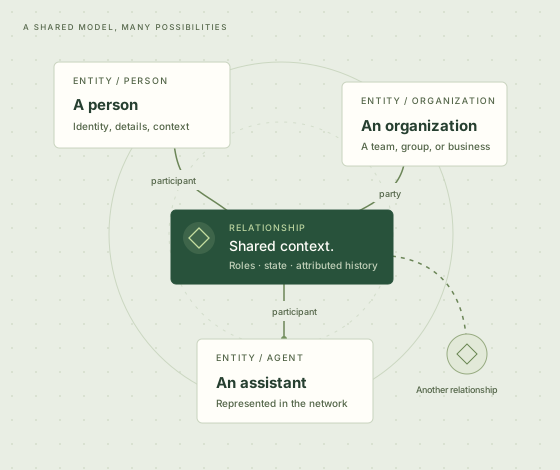
A contact tells you who someone is. A relationship carries the context: who is involved, what stage they have reached, what happened, and what can happen next. WoN gives applications and their agents a shared place to keep that context.
Represent people, organizations, agents and the relationships between them. Give each relationship named roles, its own data, and a lifecycle when it needs one.
Programs describe your types, states, commands and conditions. Build a sales pipeline, a membership model, or another application on the same small core.
People approve the collections and capabilities an agent can use. Shared records respect workspace and collection permissions, including the context an agent cannot see.
Changes carry attribution and revisions. Agents can discover allowed commands, record progress, and consume a durable change feed through REST or MCP.
Simple at the center
The core stays small. The richness comes from how you connect it and the behavior you define.
A person, organization, agent, or another type your application needs.
Named roles connect participants. A relationship can participate in another relationship, too.
Define schemas, lifecycle states, commands, conditions and views in versioned packages.
Relationships, all the way through
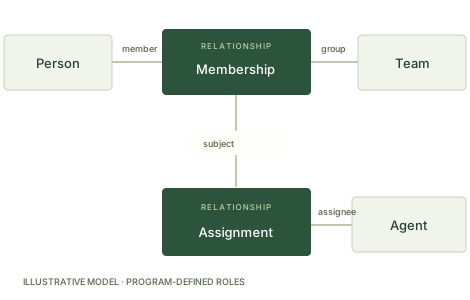
The same pattern repeats at every level. Representing a membership or assignment does not grant access; permissions are managed explicitly.
One foundation, different applications
Sales is a useful first application: contacts become participants, deals carry context, and progress follows explicit rules. It is one expression of the platform, not the limit of it.
A place for contacts, deals, interactions and next actions. People manage the pipeline, and authorized agents work with the same underlying records and commands.
Open SalePiperA deal is a relationship in motion
The bundled community program uses the same core to describe membership. Other relationship-based applications can define their own types and behavior; they do not need a new platform subsystem for every noun.
A contract your agents can use
A shared model and a set of authorized operations. Use REST or MCP to read records, discover commands, record changes, and work within the permissions a person has approved.
// A conceptual record, not a request body.
{
  "kind": "relationship",
  "type": "deal",
  "participants": {
    "buyer": [{ "id": "…" }],
    "seller": [{ "id": "…" }]
  },
  "state": "proposal"
}Explore the model. Connect an agent. See it at work in SalePiper.